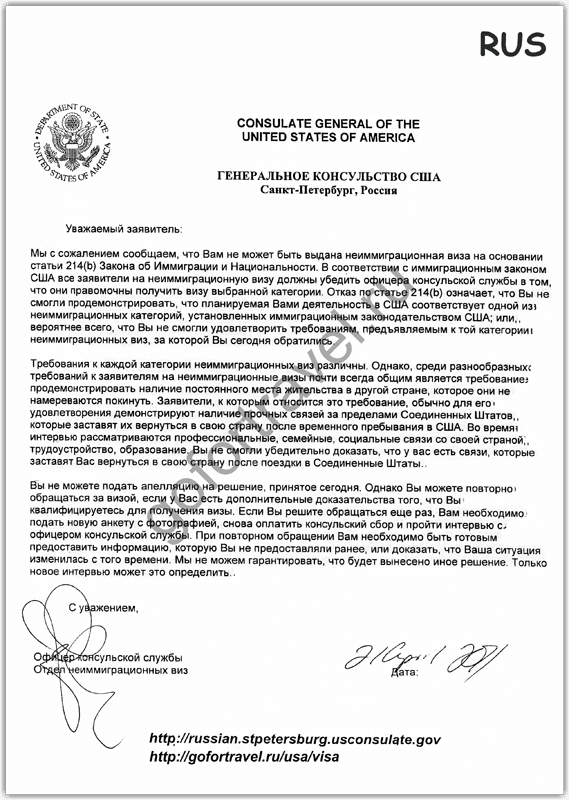
In 2026, the main basis for a U.S. visa refusal, including a B1/B2 visa refusal, is Section 214(b) of the Immigration and Nationality Act. U.S. law places the burden of proving the absence of immigrant intent on those applying for a U.S. nonimmigrant visa: the applicants themselves. Applicants for a U.S. B1/B2 nonimmigrant visa must demonstrate that their visit is temporary and for business or tourism. Applicants for F-1 student visas face a more complex task: to avoid a refusal under Section 214(b), they must demonstrate that they have the qualities needed to complete the full course of study. The U.S. Embassy officer will approve the visa rather than refuse it only if satisfied that the applicant does not intend to remain in America permanently.
Below is an interactive chart showing U.S. B1/B2 visa refusal statistics for different countries. Please note that the statistics are based on applicants’ citizenship, not the country where they apply. For example, Russian citizens currently attend interviews in Kazakhstan, Poland and other countries. However, the statistics reflect the applicant’s citizenship, rather than the interview location. Wherever Russian applicants obtain their visas, their outcomes are always counted towards Russia’s figures. Statistics for Poland, Kazakhstan and other countries reflect the outcomes of their own citizens.
Our chart allows you to examine B1/B2 U.S. visa issuance percentages for applicants from different countries and in different years, and to track changes over time. A comparison feature also lets you compare two countries, reviewing B1/B2 refusal statistics for the selected citizenships over several years. These are official U.S. Department of State figures published annually. The Department’s website provides publicly available information on U.S. visas issued to citizens of different countries during the previous fiscal year.
When applying for a visa to America, it is important to assess risks and possible refusal reasons in advance. Applicants are not refused solely because of suspected immigrant intent, as many assume. A negative decision may result from mistakes in the DS‑160, inconsistencies between the application and interview answers, visa refusals from other countries, an unconvincing U.S. travel plan or a lack of confidence at the Embassy. We invite you to take our special online test to assess your chances of obtaining a U.S. visa. It helps identify the difficulties that may arise in your particular case and your weak points. The test takes into account the main current factors considered by the U.S. Embassy in 2026.
After completing the online test, you will learn your chances of U.S. visa approval and possible reasons for refusal. Of course, this is only a basic assessment. The most accurate way to evaluate your prospects is through a personal consultation. Our visa experts will examine your situation in detail, from your visa history and purpose of travel to the DS‑160 and interview. We will identify the risks, explain how to avoid them and how to present your case in the best light. To receive professional recommendations, simply submit a request on our website.
The applicant submits visa documents and attends an interview at the U.S. Embassy. This procedure has not changed. However, consular officers now consider Russian applications somewhat differently, in connection with recent international events and developments within Russia. The embassy officer primarily considers the applicant’s age, marital status, employment, income and travel history: the standard factors. In addition, the applicant’s circumstances are assessed in the context of the current situation. In 2022, the special military operation in Ukraine began, followed some time later by partial mobilisation in the Russian Federation. After these events, the U.S. visa refusal rate among Russian citizens increased significantly. Men were particularly affected.
Why might you be refused a U.S. visa following the start of the special military operation and mobilisation? First, the officer closely examines where you currently live and where you have been since February 2022. This is easy to check using the departure and re-entry stamps in your international passport. Many Russians hurried to leave after both the announcement of the operation and the introduction of partial mobilisation. If the U.S. Embassy officer sees that the applicant has not recently been living in Russia, they regard them as a potential immigrant. Unfortunately, that is how you will be viewed in this situation, regardless of your income, extensive visa history and other factors. You have left Russia and may intend to remain in the United States after obtaining a tourist visa. This is a direct reason for refusal.
It is not the only concern in this context. Recently obtained residence permits also raise doubts and provide another reason to suspect an intention to move to America. The U.S. Embassy’s reasoning is clear: a Russian citizen does not want to live in their own country, moves abroad, does not plan to return to Russia and obtains a U.S. visa. It is logical to assume that they may try to stay in America for a long time or permanently. Many Russian applicants are therefore currently refused visas. If you recently moved abroad permanently, after the events of 2022, and decided to apply to the U.S. Embassy, be prepared for a negative decision. Officers carefully check where the applicant now lives permanently, what they do and their income. At the slightest doubt, Russians who have «fled» Russia are refused a U.S. visa.
Applicants refused a nonimmigrant visa receive a standard notice stating the reason: failure to meet visa eligibility requirements and insufficient strong ties to their home country. In reality, the reasons are much more varied. In 2026, the visa officer does not provide a detailed explanation of the decision, instead citing Section 214(b). The actual reason usually remains unknown to the applicant. Years of studying this issue have allowed us to compile the most common reasons embassy staff use to justify refusals under Section 214(b). Understanding why the officer reached a negative decision is very important, because it helps you address the situation and obtain a visa when reapplying.
1. Limited ties to the home country. This category includes young people who are unemployed, recently employed or in low-paid work; have no children; are unmarried; own no property; and/or live in rural areas. Final-year university and school students often fall into this category. At this stage of life, a person is considered highly mobile and able to adapt easily to new circumstances, and consequently more likely to immigrate. This is the most common risk group for U.S. visa applications. Refusals are not uncommon. A genuine effort is needed to convince the embassy officer that the applicant has no intention of moving abroad. Otherwise, the decision will be negative.
2. Problems during the interview. Much depends on your behaviour at the U.S. Embassy interview. The applicant’s conduct, sincerity when answering questions, appearance, reactions, eye contact, facial expressions, pauses and hesitation, inconsistencies between interview answers and the application, and nervousness are all considered when assessing their intentions and credibility. The officer then decides whether the applicant meets the visa criteria. To obtain a positive conclusion, you need to remain in control of the situation. Remember that everything is taken into account from the moment you enter the Embassy building. Your actions and answers are not merely noted: they are examined. The fewer suspicions you raise, the greater your chances of success.
3. Previous lengthy visits to the United States. Applicants often initially state that they plan a short trip, but then stay much longer. Russian applicants are generally admitted at the border for up to 180 days, and many use this allowance. However, if their next U.S. visa application again describes a short visit, their credibility may be questioned. This can have a stronger effect on the decision than all the factors listed above. Grandparents who spend considerable time in the United States helping with newborn grandchildren often encounter this problem. At some point, an embassy employee may decide that their stays in the United States are too long and refuse the visa.
The embassy employee may assume that the applicant:
- works illegally in the United States: otherwise, how do they support themselves there;
- no longer lives in their home country, or has nothing keeping them there;
- has circumstances inconsistent with the visa category requested.
4. A long planned stay stated in the application. Applicants who explain that they intend a lengthy visit to the United States may find themselves in a bureaucratic trap. In point 3, we described how concealing the intended length of a trip can make obtaining a first visa easier but lead to subsequent refusals. Conversely, being honest in the application may itself result in refusal under Section 214(b). The longer the planned trip, the greater the likelihood of refusal. If you intend from the outset to spend a long time in America, embassy rules require you to explain this at the interview. At the same time, it will be difficult to convince the officer that you have strong ties to Russia and will definitely return.
5. Few trips to Europe. The visa officer considers a good visa history essential for obtaining a U.S. visa. Extensive European travel demonstrates that the applicant has sufficient funds. Returning home despite the opportunity to remain in Europe also demonstrates strong ties to the home country. Trips to popular resorts in places such as Egypt and Turkey do not resolve this issue: few people would want to remain and work in a resort destination. You can find detailed information about travel history requirements for a U.S. visa on our website. International travel is nevertheless always an advantage, except when undertaken immediately before applying to the U.S. Embassy. In that case, it appears obvious that the trips were made to obtain the visa.
6. Relatives who previously immigrated to the United States. Applicants with relatives in the United States may be refused in 2026 for two reasons. First, having a relative in America suggests that remaining there would be easier. Second, if the relative obtained their status in a suspicious way, the visa officer may distrust the applicant or effectively punish them instead of the relative suspected of a violation. Examples include people who arrive as tourists and then apply for political asylum, or those who conceal a U.S.-based fiance or fiancee and then marry quickly. If your relatives moved in roughly this way, be prepared for difficulties at the embassy interview.
Do not try to conceal anything or avoid this question in the application. The information is held in consular records. Embassy officers often ask applicants which visa their relative used to enter the United States and how they obtained legal status. Unfortunately, even entirely innocent situations can end in refusal. For example, a participant in a summer work programme on a J visa falls in love with an American citizen and marries her, while his parents travelling to the wedding are refused visas. The officer will not be moved by this. If there is a reason for refusal, the refusal will be issued. Nor is any «statute of limitations» applied when examining such cases. Even long-standing green card holders who have lived in America for years may encounter the U.S. Embassy’s disapproval, with the applicant bearing the consequences.
7. A suspicious invitation. Weak or nonexistent ties between the host and applicant raise doubts about the legitimacy of the proposed trip and the applicant’s honesty. If you are invited by friends of friends whom you have never met, it is better not to emphasise them. The officer will not believe that casual acquaintances are the real reason for the trip. Invitations consisting of general phrases or written in poor English may also lead to a U.S. visitor visa refusal under Section 214(b). The host or the notary certifying the invitation may also be on the Embassy’s «blacklist», resulting in refusal under Section 214(b) or 212(a)(6)(c). It is therefore better not to notarise the invitation. A letter in a free format is sufficient.
8. Travel to meet a romantic partner. Invitations from American citizens to their romantic partners quite often result in refusals. In practice, it seems to make little difference whether you have known each other online for only a week or in person for many years, or whether you met in your home country or a third country. Even strong ties to the applicant’s home country receive little weight. The assumption is that an applicant in these circumstances is willing to do anything to leave their home country because the host is their «ticket to the West». The Embassy asks applicants to be honest about their travel purpose, while scrutinising visits to friends of the opposite sex. Obtaining a visa in this situation is extremely difficult.
9. Insufficient funds for the trip. If the purpose of travel to the United States is medical treatment or study, the applicant must have sufficient funds to pay the bill. It does not matter whether these are personal or sponsored funds. A bank letter showing the available balance must be presented at the interview. There is an important qualification, however. If the bank account for the U.S. visa application was opened and funded immediately before the application, the officer may suspect that the money does not belong to the applicant and that the arrangement is artificial. Choose a sponsor carefully too. Submitting a sponsorship undertaking from someone who is not a close relative with a U.S. tourist or student visa application may lead to refusal under Section 214(b).
10. A change of status during a stay in the United States. Even if the immigration service approved the change, people who changed status in the United States are frequently refused a new visa after returning home. The embassy employee may conclude that the true intention to change status was concealed in the first visa application. For example, an applicant initially gives tourism as their travel purpose but changes to H-1B status after arrival. Obtaining another tourist visa will be difficult. The reasoning is understandable: perhaps you again intend to remain in America for a long time or permanently. Having already changed status once, you would find it even easier to complete the procedure correctly a second time. Questions about this situation are certain to arise at the interview.
11. Problems obtaining a student visa. Obtaining a U.S. visa for study has always been considered difficult, particularly for longer programmes lasting two months or more. In 2026, U.S. Embassy staff quite often refuse student visas:
- if the student plans to attend a local college or a little-known university;
- if the student lacks sufficient language skills for the chosen course: F, J and M visa interviews are almost always conducted in English;
- if the student lacks economic ties to their home country, unlike more mature applicants;
- if the course specialisation conflicts with their entire previous career;
- if the chosen course has no practical application in their home country;
- if the student is beyond the usual student age, over 30;
- if their U.S. study record to date is poor, with weak grades or attendance during study on a previous F-1 visa;
- if they made limited progress in English while participating in the SWT programme in the United States.
12. Suspected fraud by the applicant. A U.S. Embassy employee may have serious doubts about the authenticity of a document presented at the interview, such as a bank statement or employment reference. Usually, however, there is neither time nor an opportunity to verify it. The U.S. Embassy in Russia places very little trust in certificates, and any hesitation when answering a question may lead to refusal on suspicion of fraud. Issuing a refusal under Section 214(b) is easier than launching an investigation for a decision under Section 212(a)(b)(c). That is why it is important not merely to prepare an employment letter, for example, but also to be ready to explain your work. There should be no doubt that you actually hold the position stated.
13. The applicant is considered an accomplice. A consular employee may refuse an entire group of applicants if one member has committed a violation. For example, if organisers secretly add an outsider to a football team’s group application and this is discovered, every team member may be refused. The same can happen if a student group includes someone whose real intention is simply to leave for the United States, or with tourist trips. Always be careful about whom you name as a travelling companion. A desire to help often ends in refusal for the whole group. You may not even know some of the people listed, but unfortunately you will not be able to prove this to the officer. They will not investigate further and will issue a refusal.
14. Shopping around for a consulate. Applying at a geographically distant U.S. Embassy or Consulate, including in another country, raises suspicions that you are trying to bypass your «home» Embassy. For example, the U.S. Embassy where you live may have a reputation for being strict, while a consulate in another city or an embassy abroad is considered more accommodating. In response to this «market research», the applicant receives a formal refusal and the case is referred to their home jurisdiction. Reapplying to a different embassy or consulate after a refusal at the first also usually ends in failure. Visa officers understand that the applicant is looking for an advantage and trying to find a certain route to approval. Such applicants naturally attract more questions and suspicions from the outset.
15. Applying for a visa in another country. Applicants sometimes apply for a U.S. visa abroad rather than in Russia for various reasons. In such cases, the risk of refusal increases considerably. Visa officers in another country may struggle to assess the applicant’s circumstances and economic and social ties to their country of permanent residence fully. However, the situation in 2026 is somewhat different: because interviews cannot be scheduled in Russia, applicants travel abroad, and some countries readily accept Russian applicants. Read which countries these are in our Applying for a U.S. Visa Abroad section. It is still best to choose countries where officers have at least some understanding of Russian circumstances. Travelling to a destination unfamiliar with those circumstances may result in refusal.
16. Leaving a family member behind as a «hostage». When an entire family plans to travel, one member may be refused a visa. For example, a student intending to accompany his parents to his sister’s wedding in the United States was refused and remained at home while the parents travelled. He was effectively left as a «hostage» to remove doubts about their return. This practice is rare but does occur. Entire families can, of course, travel to America, and visas are approved in many cases. Refusals mainly occur in situations the Embassy considers suspicious, where there is reason to believe that the family may remain permanently in the United States. One applicant is then refused to provide reassurance that the others will return.
17. A possible intention to give birth in the United States. This arrangement appeals to foreigners for an obvious reason: it gives the newborn a chance to obtain U.S. citizenship. Although no law either prohibits or permits such arrangements, almost all embassy employees refuse visas to pregnant women. Their main concern is that the birth will be paid for by U.S. taxpayers. Even if you do not intend to give birth in America and are applying for a medical consultation or simply a holiday, you may be refused if your pregnancy is apparent. The officer will not investigate your precise reason for travelling. Applicants are generally refused to avoid a publicly funded birth. If a visa is nevertheless approved, questions may also arise at the border, although that stage tends to be easier.
18. The applicant previously gave birth in the United States. If the applicant was not pregnant when she first applied for a visa but gave birth in the United States during its validity, this is unlikely to affect a new application negatively. However, if she was pregnant when first applying and concealed the true purpose of travel, the next application may be refused under Section 214(b). The chance of refusal is 100% if U.S. hospital bills remain unpaid. There was a case in which an applicant obtained another visa only after eight refusals under Section 214(b), following a charitable contribution to the clinic where her child had been born. Giving birth free of charge in America has consequences.
19. An immigration application to another country is pending. If an applicant has begun immigrating to another Western country, such as Canada, while also applying for a U.S. tourist visa, they may be considered at high risk of remaining in the United States illegally. This is a substantial reason for a U.S. visa refusal. Embassy staff’s main concern is preventing potential immigrants from entering the country. If the applicant’s actions demonstrate a desire to move abroad permanently and that nothing keeps them in Russia, they immediately fall into a risk category. There is no guarantee that, after obtaining a U.S. visa, they will not change their mind and remain in the United States. Such applicants are therefore almost always refused.
20. Previous refusals without significant changes in circumstances. Embassy employees quite often repeat a previous refusal because the applicant’s circumstances have not changed. Sometimes personal or political considerations influence their actions. This happens even when an applicant reapplies a few days after refusal with new evidence. The first question is then: «What has changed since your previous application?» Applicants often assume that changing their travel purpose, for example from tourism to study, will improve their chances of obtaining a U.S. visa. Instead, this can demonstrate desperation and reduce the prospect of approval to a minimum.





















Thank you, your question has been submitted
We have received your question and sent it for moderation. After review, it will appear on this page. We usually publish answers within 1-3 working days. At busy times, review may take a little longer, so an answer may appear later.
Bookmark this page and return in a few days to check whether your question has been answered.
Если вам нужна комплексная помощь с оформлением визы, оставьте заявку - специалист свяжется с вами и расскажет о дальнейших шагах.