Светлана Ю.


Here you will find instructions for completing the DS‑160 application and examples for different situations: tourism, visiting family or friends, studying, and applying for a child. Choose a relevant example, view the completed pages, and download the sample PDF and its Russian translation. Below, we also address common questions and difficulties when completing the form. If you need assistance, we will prepare the application using your information and send you a PDF to review before submission. To use our service, request assistance with your DS‑160 application.
The DS‑160 is the main electronic application form used when applying for U.S. nonimmigrant visas. It contains comprehensive information about the applicant, including employment, family, education, the planned trip, and previous visa applications. Its standardized format helps visa officers analyze the information and make visa decisions. For applicants, the DS‑160 remains a complex form that requires careful completion of every section, correct transliteration, and consistent answers. Any errors may make obtaining a visa more difficult. The DS‑160 is an important part of the preliminary information assessment system used by the U.S. government to improve the transparency of the visa process. The accuracy of the DS‑160 directly affects the U.S. Embassy’s final decision.
The DS‑160 is one of the main documents required when applying for a visa to the United States in 2026. Embassy staff review and analyze the application before the interview. The applicant’s information is processed through a dedicated computer system to identify potential inconsistencies and false information. Untrue statements in a DS‑160 inevitably have consequences. First, they can lead to additional questions at the interview. Second, they can provide a serious reason for refusal. A U.S. visa application must be free of errors, and the information about the applicant and the trip must be as complete and clear as possible. It is also crucial to understand how Embassy staff approach applications and what they expect to see in an applicant’s visa form, as well as what should not be included.
When speaking with travelers whose visa applications have been refused, we often hear the same question: ‘Why did the visa officer refuse my application without looking at my documents and after asking just one question?’ In such situations, the refusal decision was made before the interview. In most cases, reviewing the information in the application gives the consular service enough detail to decide whether to issue a visa. The applicant’s basic information helps officers form an initial picture of the person and their life in Russia. Bear in mind that the electronic DS‑160 can make your visa interview at the U.S. Embassy much easier or, conversely, much more difficult. It all depends on how the form was completed and what information was provided. So what in an online application can lead to a visa refusal?
Before completing the electronic application for a U.S. nonimmigrant visa, it is important to assess the applicant’s situation as a whole, including its strengths and weaknesses. Based on this assessment, a consistent approach to the U.S. visa application should be established. It should be as straightforward and logical as possible for the visa officer and the applicant alike. This matters because the clearer the applicant’s situation, the fewer questions it will raise. The visa application form is the foundation of this approach. Completing the DS‑160 in 2026 involves more than translating words from one language into another: above all, it shapes the course of the entire visa application process. That is why we recommend seeking assistance with the DS‑160 rather than completing it on your own. It is a particularly important part of applying for a U.S. visa, and mistakes cannot be corrected afterward.

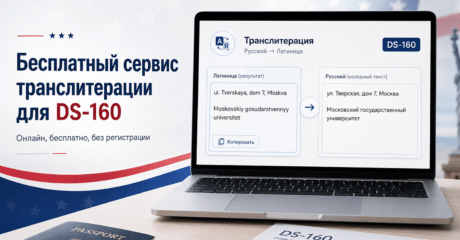
Use our online transliteration tool to prepare your information for the DS‑160. It helps you quickly write addresses and the names of streets, organizations, and educational institutions in Latin letters. Simply enter text in Russian, get the result, and copy it into your application. Conversion is instant and takes place directly in your browser. The tool’s page also includes a letter correspondence table and explanations of the transliteration rules to help you understand how words and letter combinations are written.
The steps below explain how to complete the DS‑160, from preparing your information to saving the confirmation page and a full copy of the submitted form. The cards will help you gather the necessary details in advance, retain access to an unfinished application, and check your answers before submission. If you are unsure about a step, refer to your documents and the explanations provided for each field, and use the examples in the context of your own situation. In the next section, you will find completed applications for different travel purposes.
In 2026, it is particularly important to complete the DS‑160 application for a U.S. visa correctly. The U.S. Department of State and the Trump administration have significantly tightened the requirements for applicants, increased scrutiny, and changed the way applications are assessed. Visa officers may previously have overlooked individual inaccuracies or omissions, but the DS‑160 is now reviewed much more strictly, including automated scoring of the information before the interview. Errors, inconsistencies, incorrect transliteration, or illogical information can substantially reduce the chances of obtaining a visa. This makes it essential to complete the application as fully, carefully, and consistently as possible.
Our specialists handle the entire preparation of the DS‑160 application, carefully following the current U.S. Department of State requirements and the procedures of the particular Embassy where the interview will take place. Our staff complete the application up to the Review stage and then send it to you for checking. You can examine every section, confirm that the details are correct and consistent, and check that the information matches your documents and actual circumstances. No information is submitted to the Embassy without your confirmation. Once approved, the application is signed and submitted to the U.S. Embassy, and the final version is provided for your personal records and subsequent interview preparation.
For your convenience, and for applicants who prefer to prepare their documents themselves, we have prepared examples of correctly completed DS‑160 applications for 2026. Below, you will find sample applications for different purposes: tourism, visiting family or friends, education, and student programs, as well as examples for different applicants, including a woman, a man, and a child under 14. Other examples are also available on our website, including a DS‑160 for a business trip and a sample for a visa for maritime crew members. If you have questions after reviewing the examples, you can contact our specialists using the details provided or leave a question in the comments at the bottom of the page.
Below is a sample DS‑160 for a B1/B2 visa for tourism, based on the circumstances of an actual applicant: a married man living in Russia who is planning a trip to the United States with his wife and children. The ‘Personal Information’ section shows in detail how to list multiple citizenships, enter current passport details, provide different residential and mailing addresses, and include several telephone numbers and email addresses. Particular attention is given to the ‘Social Media’ section, which lists active Instagram, VK, YouTube, and Telegram accounts and demonstrates how to describe the circumstances of losing a previous passport containing a U.S. visa.
The ‘Travel Information’ section provides an example of a family travel itinerary for the United States, including dates, flights, arrival in Los Angeles, a flight to Hawaii, and a detailed list of planned destinations such as museums, natural parks, and major attractions. The ‘Previous U.S. Travel’ and ‘Last U.S. Visa’ sections show how to record previous visits to the United States, details of the most recent visa and its loss, a refusal under section 214(b), and an immigrant petition filed by a brother who is a U.S. citizen. The ‘U.S. Contact Information’ section demonstrates how to enter the details of the hotel where the applicant plans to stay.
The application then covers ‘Family Information’ and ‘Work/Education/Training Information’, showing how to enter details about parents, a brother, a spouse, and children, describe current employment and job duties, and report work in the applicant’s own business and previous employment. The example also includes two educational institutions, a list of countries visited, language skills, and detailed military service information, including the branch of service, rank, military specialty, and dates of service. All information in the examples is fictional and is provided solely for demonstration purposes


A sample application for a man traveling with his wife and children as tourists. See how the itinerary, hotel, travel companions, and employment are entered to help prepare the information for your own application. PDF, 2.06 MB.
A Russian translation of the questions and answers in the tourism application. Compare it with the English example to understand the travel, family, and employment sections and the meaning of the completed fields. PDF, 962 KB.
This sample DS‑160 was completed for a retired woman applying for a B1/B2 visitor visa to visit relatives in the United States. The ‘Personal Information’ section shows how to enter personal details, a maiden name, marital status, home address, and contact telephone numbers. ‘Passport/Travel Document Information’ demonstrates how to enter passport details and describe the loss of a previous document. The ‘Social Media’ section shows how to list the social networks the applicant uses. ‘Travel Information’ then demonstrates how to specify a family visit, the main dates, and intended destinations. ‘Person/Entity Paying for Your Trip’ shows how to name a sponsor when a relative covers the costs. ‘U.S. Contact Information’ provides an example of entering the U.S. host: the relative whom the applicant plans to visit and at whose address she will stay.
The following sections show how to provide information about parents, immediate relatives in the United States, and former spouses in ‘Family Information’. ‘Work/Education/Training Information’ demonstrates how a retired applicant can correctly state their current status, list previous jobs with descriptions of the main duties, and enter details of universities, languages studied, and countries visited in recent years. The final part of the application provides an example of consistently answering the ‘Security and Background’ questions and completing ‘Location Information’ and ‘Preparer of Application’. This example illustrates a carefully completed and logically consistent DS‑160 for a retired person applying for a B1/B2 visitor visa to visit a relative in the United States.


A sample application for a retired woman visiting relatives in the United States, with the host paying for the trip. It shows how to enter the accommodation address, trip funding, relatives, and previous employment. PDF, 1.85 MB.
A Russian translation of the questions and answers in the family visit example. It explains the wording about relatives in the United States, the person paying for the trip, and the applicant's employment status after retirement. PDF, 232 KB.
Below is a sample DS‑160 for an F1 student visa for language courses in the United States. It is worth reviewing carefully if you plan to study in the United States and apply for an F1 visa. The opening sections show how to correctly enter personal details, addresses, telephone numbers, email addresses, current passport details, and information about lost passports, as well as social media accounts on different platforms. The example shows how to complete the sections about previous U.S. trips, visas issued in the past, and the grounds on which they were obtained in a consistent way.
The second part explains in detail how to select ‘Academic or Language Student (F)’ as the purpose of travel and ‘Student (F1)’ as the subtype, enter the intended arrival date and accommodation during the course, and provide details of the person paying for the studies and the trip, in this case the applicant’s husband. The example also shows how to complete the host details in ‘U.S. Contact Information’ when the contact is an educational institution. It separately illustrates how to enter information about parents, a spouse, relatives in the United States, previous education, and current employment in Russia.
Particular attention is given to ‘Student/Exchange Visa Information’, which appears only when applying for an F1 visa. The example shows how to carefully transfer all the information from Form I-20, including the SEVIS ID, the educational institution’s full name, the study program, and its address. The same section includes an example of ‘Additional Point of Contact Information’, showing how to list people who know about the applicant’s planned studies in the United States and can confirm the purpose of the trip. The example includes two such contacts with their addresses, telephone numbers, and email addresses. Finally, remember that all the information in the application is entirely fictional and is provided only for demonstration purposes.


A sample application for language courses in the United States, with the applicant's spouse paying for the trip. See how the study purpose, educational institution, funding, and education are entered to help prepare your own information. PDF, 2.04 MB.
A translation of the questions and answers in the language course application. Review the English wording about studies, the educational institution, and payment for the trip to prepare for completing your own DS‑160. PDF, 248 KB.
When applying for a U.S. visa, applicants often ask about the specific requirements for completing the DS‑160 for women and children: are the forms exactly the same regardless of gender and age, or do they differ? Every applicant completes a DS‑160, but the form may change depending on the information entered. Please note that immigration authorities periodically change visa application rules. This also applies to the DS‑160, so it is important to follow current news. In 2026, completing the DS‑160 for a woman is no different from completing the same form for a man: carefully enter the applicant’s information in Latin letters using the U.S. Embassy’s transliteration rules, answer the same questions, and upload a photograph. There are no significant special requirements.
Before 2026, however, the DS‑160 for women was shorter: information about education, previous employment, and travel history was not required. This prompted questions and discussion among applicants. The DS‑160 now contains all the sections of the full version. The situation is different when applying for a U.S. visa for a child: the application changes according to age. Children over 14 answer all the questions, just like adults, while children under 14 are asked substantially fewer questions. The form for applicants under 14 is significantly adjusted, which is quite logical. It omits information about current employment or studies, education, and foreign countries visited in the last five years. Below, you can view an example of a completed DS‑160 for a child.
Strictly speaking, there are relatively few differences when completing the DS‑160 for different categories of applicants. The questions are broadly the same, and the main differences relate to age. However, remember that every case is unique, and errors or inaccuracies in a U.S. visa application can lead to a refusal. Officers examine applicants’ forms carefully and form an initial impression from them. Take care and review the sample DS‑160 applications for women and children in this section. Alternatively, seek professional assistance from our team, who can complete the DS‑160 in English accurately and promptly and help present your overall situation in the most favorable light with the aim of a positive outcome.
Below is a sample DS‑160 for a B1/B2 visa, completed for a woman planning a tourist trip to the United States with her husband and children. ‘Personal Information’ shows how to correctly enter the applicant’s details, including a former surname, several email addresses, additional telephone numbers, and social media accounts (Instagram, VK, YouTube, Telegram). The application also demonstrates how to report a previously lost passport so that the information is logical, clearly structured, and consistent with other sections.
The ‘Travel Information’ section shows how to enter an itinerary when the applicant is traveling with her family: dates, flights, the U.S. accommodation address, and the list of places to visit match the information in her husband’s and children’s applications exactly. It provides an example of correctly stating that the husband is paying for the trip even though the applicant is employed and has a steady income. ‘Previous U.S. Travel’ shows how to enter past U.S. visits and describe a J-1 visa refusal received in 2010 under section 214(b). ‘Family Information’ records that the applicant’s brother lives in the United States as a lawful permanent resident (LPR).
The ‘Work/Education/Training Information’ section demonstrates how to describe the applicant’s current employment as a chief accountant, with detailed information about her duties and the nature of her work. The application also shows how to list a previous job and two educational institutions, including their names, addresses, fields of study, and attendance dates, so that the information is complete and consistent. It concludes with a sample list of countries visited in the last five years. All the details illustrate what a complete, logical, and carefully structured DS‑160 should look like for a woman traveling with her family.


A sample application for an employed woman traveling with her family, with her spouse paying for the trip. See how her former surname, employment, and travel companions are entered so that you can check your own information before completing the form. PDF, 1.86 MB.
A Russian translation of the questions and answers in the example for a woman. It helps explain the sections about a change of surname, spouse, employment, and trip funding, and helps you compare related information in family members' applications. PDF, 689 KB.
Below is a sample DS‑160 completed for a child under 14 traveling to the United States with their parents. It shows how to enter the child’s basic biographical details, passport information, home address, and parents’ contact telephone numbers in a consistent way. ‘Travel Information’ demonstrates how to enter the purpose of the visit, travel dates, arrival and departure cities, and the U.S. accommodation address, which should match the parents’ applications. ‘Person/Entity Paying for Your Trip’ shows how to name a parent as the sponsor by selecting ‘Other Person’ and entering their name, telephone number, email address, and relationship to the child. ‘Persons Travelling With You’ illustrates how to list both parents and other family members following the same itinerary.
The DS‑160 for children under 14 is substantially shorter than the adult form. It does not include sections on current employment, education, previous jobs, job duties, or countries visited in the last five years, as this information is requested only from adults. It does, however, retain questions about previous U.S. visas, past trips, the U.S. contact, and the full ‘Security and Background’ section, which parents answer on the child’s behalf. The example illustrates a logical DS‑160 for a child traveling with their family, with information consistent with the parents’ applications.


A sample application for a child traveling to the United States with their parents. See how the child's details, travel companions, and family are entered so that you can compare the travel information with the adults' applications. PDF, 1.54 MB.
A general translation of DS‑160 questions with explanations of the fields. It helps parents understand the passport, family, and travel questions when preparing a child's application; the set of questions in a child's form may differ. PDF, 689 KB.
Completing the DS‑160 is one of the most important stages of applying for a U.S. visa. The officer reviews the application before meeting the applicant at the interview. It is the basis of an initial impression that can sometimes be very difficult to change. The DS‑160 should therefore be completed very carefully, without errors or typos. To help applicants, we have collected the most frequently asked questions about the DS‑160 and answered them below. You can find more questions and answers about preparing the visa form in our main DS‑160 Questions and Answers section. In addition, you can always use the feedback form at the bottom of the page. Ask our specialists a question: wherever possible, we provide detailed and useful guidance.
The U.S. visa application is the electronic DS‑160 form, a standard form containing questions and answers. The DS‑160 is completed online at https://ceac.state.gov/genniv/, in English only. It asks for information about the applicant, their passport, employment or studies, education, marital status, relatives, foreign travel, plans for the U.S. trip, and more. The DS‑160 is a very important part of a U.S. visa application: the Embassy reviews and checks it before the in-person interview. A preliminary visa decision is often made based on the form. You should therefore take care to avoid errors and typos. There are specific rules for completing it. One is the use of a transliteration system to spell proper names correctly.
The U.S. visa application cannot be downloaded and completed by hand. It can only be completed electronically. Applicants are given enough time to work on the DS‑160, and you do not have to complete it in one uninterrupted session. You can save the form and continue later, but you need to write down its number and remember the answer to the security question. Remember to click ‘Save’ as you work so that the application is not lost. At the end, confirm the DS‑160 and submit it to the Embassy for review. Please note: you cannot make any changes after that. Print the DS‑160 confirmation page for the interview; a printed copy of the full application is not required. However, it is a good idea to save the application for your records, as this will make it easier to retrieve your information the next time you apply for a visa.


U.S. immigration authorities use a shared database. It is therefore understood that all applications completed by an applicant can be available to officers at any U.S. Embassy, and this is indeed the case. Officially, you do not need to complete the DS‑160 again if the city or country where you apply changes. In practice, however, the situation can be different. Many applicants’ experiences show that problems can arise if the form lists an interview location that is no longer current. Imagine arriving at the Embassy only to discover that your application cannot be found. Unfortunately, officers often cannot quickly locate a DS‑160 completed for a different Embassy. The system simply does not load the required form, and the applicant cannot be seen. In that case, the scheduled U.S. visa interview is canceled.
The interview is canceled, rather than rescheduled, and the applicant is asked to book a new appointment through the standard process. This means that selecting the wrong embassy may force you to return home and search for another available appointment in the calendar, just like any other applicant. There is no separate queue for this situation. This costs both time and money, since all interviews for Russian applicants currently take place abroad. It is therefore better to avoid the risk and spend a little time completing a new DS‑160 that lists the correct U.S. Embassy. This will give you peace of mind. Remember to enter the new application number in your profile and then print the appointment confirmation showing the updated number. The information in your documents must match.

For the embassy to review your DS‑160 application, you need to upload a photograph. This is the digital photo for your U.S. visa. The photograph must meet several requirements: it must be recent (taken within the past 6 months), clear, well lit, and square (5 x 5 cm). This photograph cannot be used for other visas. To avoid problems and errors, it is best to visit a photo studio and save the resulting photo to a USB flash drive. You can then upload the finished photograph while completing your application. If you run into any problems, check the instructions on our website. We explain in detail how to take a U.S. visa photo and which standards it must meet. We also discuss the most common mistakes and provide practical tips for correcting them.


You can correct a mistake in the DS‑160, but not in every situation. Applicants can edit the form before confirming and submitting it. Once you have completed the form, but before you confirm it, you will be asked to review it. If you find a mistake at this stage, click Edit and correct the information. However, if you have already confirmed your DS‑160, you cannot make any further changes. You then have two options: leave it as it is or create a new application. The best approach depends on how serious the mistake is. Minor typos and inaccuracies are acceptable. If the information is important, however, it is better to complete the form again. To save time, you can retrieve your DS‑160 by entering its number and the answer to your security question. Most of the application information is retained.
Complete the remaining fields, correct your mistakes, save the application, and submit it for review. Remember that the new form will have a new application number. You must enter that number in the profile used to book your interview. If you have already created a profile and entered the previous application number, update it and print a confirmation with the current information. Please also note that the officer will have access to both versions of your DS‑160. The changes should therefore not be substantial. For example, in the first application, you state that you have relatives in the United States and are traveling to visit them. If your second application says that you have no one in the United States and are traveling solely as a tourist, the embassy will be suspicious. Which version is true? Unfortunately, discrepancies this serious may lead to a U.S. visa refusal.


You can complete the DS‑160 in stages. If you have filled in a few pages but want to take a break to check some information, you can easily do so. You will not have to start again. Simply save the application. Most importantly, write down its number: the ten characters highlighted in red in the upper-right corner of the page. When you click Save, your DS‑160 is saved on the server for 30 days. During this period, you can open the application and continue whenever it is convenient. To do this, click Retrieve application on the home page and enter your application number, the first five letters of your surname, your year of birth, and the answer to your security question. Remember that this method gives you access to the DS‑160 for only 30 days. If you do not save it again or confirm it using Sign and Submit, the application will be deleted.
There is a second option for keeping your DS‑160 for longer. This is particularly useful if you are waiting a long time for an interview appointment and significant changes may occur before the interview. While completing the application, click Save application to file. Your DS‑160 will then be saved as a file on your computer, where you can keep it indefinitely. When you decide to continue, select the country and city where you will apply on the website’s home page, then click Upload application and upload your file. You can then continue completing the form and edit the information you previously entered. You can change any field before confirming the application. Once the DS‑160 has been signed and submitted, however, you can no longer make changes.


At a U.S. Embassy interview, applicants are asked various questions. Many of these have already been answered in the online DS‑160. It is very important that the information in your application matches your interview answers exactly. Any discrepancies may lead to detailed questioning and even a U.S. visa refusal. Before your interview, it is therefore advisable to review your completed application and prepare for the conversation. The DS‑160 system allows you to save and print the form when you sign and submit it to the embassy. Please note, however, that you can save and print the DS‑160 only once. If you submitted it without saving it, you will no longer have access to the information in the form. You can view your DS‑160 confirmation again, but not the application itself.
In this situation, there is only one option: create a new application based on the old one. On the website’s home page, enter your old application number, the first five letters of your surname, and the answer to your security question. Then click Retrieve an application. You will see a new form with a new number, but almost all the information from your previous application will be restored. You do not need to complete the new DS‑160; you can simply review the information you entered earlier. This may help you avoid mistakes during your interview with the officer. There are no other ways to retrieve information from a completed DS‑160 if you did not save it. We also recommend checking all your supporting documents: they should substantiate the information in your application. Remember that officers always review the DS‑160 carefully.


When completing the DS‑160, you have a time limit of 20 minutes per page. If you are working on the application but remain inactive for 20 minutes, without entering or changing any information, the system automatically ends your session. You are then logged out of the application. You cannot simply go back; you must access the application again to continue. If you did not save its number, you will have to start a new application. It is therefore best to write down your DS‑160 application number as soon as you create the form. If your session ends unexpectedly, you can then retrieve your application and continue. Please note that information is saved automatically only when you move to the next page. If the session expires before you save your data, you will have to enter it again.

If you are having difficulty completing the DS‑160 for a U.S. nonimmigrant visa, or simply do not want to spend time figuring it out, you can contact Go for Travel. We will translate your visa application promptly and professionally, understanding its importance within your U.S. visa application documents. With help from our specialists, you can be confident that your visa application is completed correctly and meets all U.S. Embassy requirements. We will not only enter your information into the electronic form, but also present it in the most favorable light. The emphasis will be on the applicant’s strengths. Please note that completion of the electronic DS‑160 is included in the price of our comprehensive visa support service.
Applicants sometimes hesitate to let someone else complete their DS‑160, even a professional agency. They worry that incorrect or false information might be entered, or that their details might be presented inaccurately. With us, you will not have these concerns. Before submitting the DS‑160 to the U.S. Embassy, we always send the applicant a PDF copy for review. This allows you to check that the form has been completed correctly and that your information has not been misrepresented. We confirm and submit the application to the embassy only after the applicant has approved it. We introduced this practice to give our clients peace of mind and make sure they know exactly what the visa officer can see. It will also help during the interview, because you will know how your application has been completed.
At our company, we value your time. When you order an application translation from us, you will not need to wait in lines, complete forms, or travel somewhere to book an interview yourself. We will ask you the application questions verbally, take your photograph, and advise you on the documents required for a U.S. visa. You will receive sample certificates so that you can prepare them correctly the first time. We will guide you through every stage of applying for a U.S. visa, including the interview with the officer. We will also submit your documents to the U.S. Embassy and schedule your interview date and time. Having Go for Travel translate your visa application is convenient: obtaining a U.S. visa involves just one visit to our office and one visit to the embassy for your interview. Delivery of your passport and visa to any address is available.

Организовать поездку в Америку довольно трудно. Нужно подготовить документы, получить американскую визу, спланировать оптимальный маршрут. Туристов ждут финансовые затраты, а также длительный перелет через океан. Поэтому жаль ограничиваться лишь одним...
Для получения американской визы каждый заявитель должен подготовить анкету DS‑160. Она заполняется только на английском языке с использованием правил транслитерации Посольства США. На этом этапе у многих заявителей возникают сложности:...
Американские власти продолжают политику ужесточения правил иммиграционного законодательства. Новая инициатива была озвучена Службой гражданства и иммиграции (USCIS) 22 мая 2026 года. Согласно опубликованному заявлению USCIS, вводится новый порядок получения вида...
Правительство США продолжает бороться с нелегальными мигрантами, в том числе ужесточая визовую политику. В рамках новых правил оформления визы в США для ряда стран было введено правило визового залога (Visa...
В последнее время появлялось множество тревожных обсуждений и слухов о программе DV (лотерея Green Card 2027). Пользователи и эксперты тематических чатов выдвигали самые разных теории – об отмене лотереи, о...
В 2026 году в США (а также в Мексике и Канаде) будет проходить главный футбольный турнир – FIFA World Cup 26. И многие болельщики планируют посетить матчи Чемпионата мира по...
Госдепартамент США опубликовал официальные данные по одобрению туристической визы США B1/B2 гражданам разных стран. По официальной статистике отказов в визе США B1/B2, данные представлены за прошедший финансовый год, охватывая период...
14 января 2026 года Государственный департамент США опубликовал официальное руководство, посвященное изменению практики обработки и выдачи иммиграционных виз для граждан стран, которые по внутренним оценкам американских властей относятся к категории...
В последнее время вокруг лотереи Diversity Visa появилось много тревожных сообщений, из-за которых у заявителей возникает ощущение неопределенности и паники. Считаем необходимым сразу прояснить ситуацию и отделить факты от домыслов....